Orcasphere Blog
Science, policy, and education for orcas and their ecosystem
Thursday, April 27, 2006
Wednesday, April 05, 2006
SRKW Symposium


Southern Resident Killer Whale Symposium 2006
NOAA NW Fisheries Science Center, Seattle, WA. Apr 3- 5
There have been approximately 650 oil spills in the Puget Sound area since 1985. In 2006, NOAA developed a response team, tug, and increased safety standards for single-hulled ships. The maximum number of Southern resident killer whales occurred in 1996 at 97 individuals. The United States has two protection acts. The goal of the Marine Mammal Protection Act (MMPA) is to restore stocks to optimum sustainable levels. The goal of the Endangered Species Act (ESA) is to develop protective, regulations, define critical habitat, and develop a Recovery Plan. Critical habitat is defined as the biological and physical elements essential for conservation. In 2001, a petition was submitted to the ESA committee to list the southern residents as ‘endangered’. In 2002, the committee voted not to list the population as endangered on the fact that they are not recognized as a separate species. In 2003, this population was listed as ‘depleted’ under the MMPA. In 2004, the southern residents were listed as ‘threatened’ as a ‘distinct population segment’ (DPS). The population was determined as significantly different because of is distinct acoustic and behavioral cultural traits, genetics, and morphology. Culture is defined as learned knowledge or behavior passed though generations that are important for survival. For example, the southern residents engage in greeting ceremonies whereas the northern residents beach rub. In 2005, a MMPA Conservation Plan was developed. On February 16 2006, the southern residents were officially listed as ‘endangered’ under the ESA. Research is needed on sound, prey, and toxic pollution. Canada implemented the Species at Risk Act (SARA) in 2003 to designate habitat and develop Action, and Recovery, Plans for species at risk (SAR). Species at risk are defined as those with ‘threatened’ or ‘endangered’ listings. There are four ecotypes of killer whales in British Columbia, southern and northern resident (fish-eating), offshores, and transients (meat-eaters). The southern residents are listed as ‘endangered’, the northern residents as ‘threatened’, the offshores as of ‘special concern’, and the transients as ‘threatened’. Within a year of listing, Action and Recovery Plan are developed. Transient killer whales were listed as ‘threatened’ in 2006 and thus require plans by 2007. The plans for the residents are to promote long-term viability, preserve geographic conditions, and preserve matrilines with multiple generations. Objectives; adequate and accessible food supply, chemical and biological pollution, disturbance from human activity, critical habitat and acoustic environment protection. The management process is to monitor, determine, investigate, and identify threats. The precautionary principle must be untilised because for long-lived species we may never know long-term effects.
Friday, March 31, 2006


Tuesday, March 21, 2006
Friday, March 10, 2006
Saturday, February 25, 2006
West Coast Birds Dying
Thousands of seabirds dying along the coast of B.C.
Published: Friday, February 24, 2006
Countless thousands of seabirds are mysteriously washing ashore dead along the B.C. coast this winter from the west coast of Vancouver Island to the Queen Charlotte Islands.
"It's spooky to see them coming in like that," Pete Clarkson, assistant chief warden at Pacific Rim National Park Reserve at Long Beach, said Thursday in an interview.
The massive die-off of seabirds this winter follows the near-complete failure of at least two seabird nesting colonies last spring.
About 1,000 glaucous-winged gulls failed to successfully breed at Cleland Island, a provincial ecological reserve northwest of Tofino, while about 400 glaucous-winged gulls and 300 rhinoceros auklets failed to breed at Seabird Rocks, south of Barkley Sound.
Curiously, up to 200 of the gulls successfully bred at Florencia Islet north of Barkley Sound, a colony that might have benefitted from its location just two kilometres from a local garbage dump.
"That's the only thing I can think of," Clarkson said. "It's a strong suspicion."
Thousands of seabirds were also reported washing ashore or breeding with poor success on the U.S. Pacific coast between California and Washington, including the mass starvation deaths of murres on Tatoosh Island off the Olympic Peninsula.
U.S. scientists speculate the deaths may be associated with warmer weather and changes in winds and currents that might have reduced the availability of the birds' marine food.
Clarkson said the first wave of seabirds, red phalaropes, began washing ashore in large numbers around last Christmas on the beaches of Pacific Rim park. The small shorebirds looked emaciated. "They appeared to be starving, minimal body fat," he said.
Northern fulmars, western grebes, common murres, and rhinoceros auklets were among the seabird species that washed ashore at the Carmanah light station.
Clarkson noted that a similar die-off of phalaropes occurred about three years ago. An examination of their gizzards found plastic pellets or nodules produced for manufacturing consumer products. These pellets find their way into the ocean only to be ingested by seabirds feeding on the surface.
While these plastics pose an environmental and ecological problem, they are not thought to have caused the death of the phalaropes, Clarkson said.
Then, after last Christmas and into January, large numbers of Cassin's auklets began washing ashore on the west coast of Vancouver Island. "I sense it's specific to a food source, or somehow a problem in that food web," Clarkson said.
Surveys found three to seven dead auklets per kilometre on beaches in the park.
On the east coast of the Queen Charlottes, officials also reported large numbers of ancient murrelets, marbled murrelets, and Cassin's auklets being found dead.
The total number of birds dead all along the coast would have ranged into the thousands, he said.
Various bird carcasses have been sent to the provincial lab in Abbotsford for analysis, while federal scientists with the Canadian Wildlife Service in Delta and Sidney gather information in an effort to find the cause of the massive die-off and consider the implications on overall populations.
http://www.canada.com/vancouversun/news/story.html?id=736d8450-eb25-4016-b411-b776f3a8537f&k=14758
Published: Friday, February 24, 2006
Countless thousands of seabirds are mysteriously washing ashore dead along the B.C. coast this winter from the west coast of Vancouver Island to the Queen Charlotte Islands.
"It's spooky to see them coming in like that," Pete Clarkson, assistant chief warden at Pacific Rim National Park Reserve at Long Beach, said Thursday in an interview.
The massive die-off of seabirds this winter follows the near-complete failure of at least two seabird nesting colonies last spring.
About 1,000 glaucous-winged gulls failed to successfully breed at Cleland Island, a provincial ecological reserve northwest of Tofino, while about 400 glaucous-winged gulls and 300 rhinoceros auklets failed to breed at Seabird Rocks, south of Barkley Sound.
Curiously, up to 200 of the gulls successfully bred at Florencia Islet north of Barkley Sound, a colony that might have benefitted from its location just two kilometres from a local garbage dump.
"That's the only thing I can think of," Clarkson said. "It's a strong suspicion."
Thousands of seabirds were also reported washing ashore or breeding with poor success on the U.S. Pacific coast between California and Washington, including the mass starvation deaths of murres on Tatoosh Island off the Olympic Peninsula.
U.S. scientists speculate the deaths may be associated with warmer weather and changes in winds and currents that might have reduced the availability of the birds' marine food.
Clarkson said the first wave of seabirds, red phalaropes, began washing ashore in large numbers around last Christmas on the beaches of Pacific Rim park. The small shorebirds looked emaciated. "They appeared to be starving, minimal body fat," he said.
Northern fulmars, western grebes, common murres, and rhinoceros auklets were among the seabird species that washed ashore at the Carmanah light station.
Clarkson noted that a similar die-off of phalaropes occurred about three years ago. An examination of their gizzards found plastic pellets or nodules produced for manufacturing consumer products. These pellets find their way into the ocean only to be ingested by seabirds feeding on the surface.
While these plastics pose an environmental and ecological problem, they are not thought to have caused the death of the phalaropes, Clarkson said.
Then, after last Christmas and into January, large numbers of Cassin's auklets began washing ashore on the west coast of Vancouver Island. "I sense it's specific to a food source, or somehow a problem in that food web," Clarkson said.
Surveys found three to seven dead auklets per kilometre on beaches in the park.
On the east coast of the Queen Charlottes, officials also reported large numbers of ancient murrelets, marbled murrelets, and Cassin's auklets being found dead.
The total number of birds dead all along the coast would have ranged into the thousands, he said.
Various bird carcasses have been sent to the provincial lab in Abbotsford for analysis, while federal scientists with the Canadian Wildlife Service in Delta and Sidney gather information in an effort to find the cause of the massive die-off and consider the implications on overall populations.
http://www.canada.com/vancouversun/news/story.html?id=736d8450-eb25-4016-b411-b776f3a8537f&k=14758
Saturday, February 18, 2006


Tuesday, February 14, 2006
WWOANW Guidelines
The Whale Watch Operators Association Northwest has updated their
2006 Guidelines and Best Practices for Commercial Whale Watching Operators
2006 Guidelines and Best Practices for Commercial Whale Watching Operators
Wednesday, February 08, 2006
Ambergris - Grey Amber
Whale 'vomit' sparks cash bonanza
(Image: ambergris.co.nz)

An Australian couple who picked up an odd-looking fatty lump from a quiet beach are in line for a cash windfall.
Leon Wright and his wife took home a 14.75kg lump of ambergris, found in the innards of sperm whales and used in perfumes after it has been vomited up.
Sought after because of its rarity, ambergris can float on the ocean for years before washing ashore.
Worth up to $20 a gram, Mr Wright's find on a South Australian beach could net his family US$295,000 (£165,300).
At first, Mr Wright and his wife Loralee left the strange lump on the beach where it was found.
However, two weeks later the couple returned to Streaky Bay and found it still lying there. Curious, Mrs Wright persuaded her husband to take it home.
AMBERGRIS FACTS
Found in warm water oceans around the world
Bile secreted by sperm whales as a digestion aid
Solidifies and floats on water, sometimes for years
Used in perfumes, medicines, flavourings
Banned in US under endangered species legislation
Internet investigations failed to resolve the mysterious matter of the lump's identity, so the couple turned to local marine ecologist Ken Jury for help. "I immediately decided it was ambergris - it couldn't be anything else," Mr Jury told Australia's ABC radio.
Mythologised for thousands of years, ambergris has been referred to as "floating gold" by scientists and scavengers who long for a windfall amid the surf.
Expelled from the abdomen of the giant sperm whale, often while hundreds of kilometres away from land, ambergris is a natural excrement thought to be used by the whale as a digestion aid.
The hard beaks of giant squid, a main source of food for the whale, have often been found inside lumps of ambergris.
Initially, ambergris is a soft, foul-smelling waste matter that floats on the ocean.
But years of exposure to the sun and the salt water of the ocean transform the waste into a smooth, exotic lump of compact rock that boasts a waxy feel and a sweet, alluring smell.
"It's quite remarkable when you think about it, because when the whale throws this out, it's discarded material that they can't digest," Mr Jury explained.
"[But] after 10 years, it's considered clean and all you're getting then is the wonderful musky, very sweet perfume, which I've got to say is ultra smooth - it's unbelievable."
http://news.bbc.co.uk/2/hi/asia-pacific/4642722.stm
(Image: ambergris.co.nz)
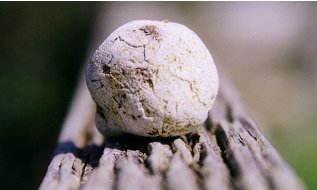
An Australian couple who picked up an odd-looking fatty lump from a quiet beach are in line for a cash windfall.
Leon Wright and his wife took home a 14.75kg lump of ambergris, found in the innards of sperm whales and used in perfumes after it has been vomited up.
Sought after because of its rarity, ambergris can float on the ocean for years before washing ashore.
Worth up to $20 a gram, Mr Wright's find on a South Australian beach could net his family US$295,000 (£165,300).
At first, Mr Wright and his wife Loralee left the strange lump on the beach where it was found.
However, two weeks later the couple returned to Streaky Bay and found it still lying there. Curious, Mrs Wright persuaded her husband to take it home.
AMBERGRIS FACTS
Found in warm water oceans around the world
Bile secreted by sperm whales as a digestion aid
Solidifies and floats on water, sometimes for years
Used in perfumes, medicines, flavourings
Banned in US under endangered species legislation
Internet investigations failed to resolve the mysterious matter of the lump's identity, so the couple turned to local marine ecologist Ken Jury for help. "I immediately decided it was ambergris - it couldn't be anything else," Mr Jury told Australia's ABC radio.
Mythologised for thousands of years, ambergris has been referred to as "floating gold" by scientists and scavengers who long for a windfall amid the surf.
Expelled from the abdomen of the giant sperm whale, often while hundreds of kilometres away from land, ambergris is a natural excrement thought to be used by the whale as a digestion aid.
The hard beaks of giant squid, a main source of food for the whale, have often been found inside lumps of ambergris.
Initially, ambergris is a soft, foul-smelling waste matter that floats on the ocean.
But years of exposure to the sun and the salt water of the ocean transform the waste into a smooth, exotic lump of compact rock that boasts a waxy feel and a sweet, alluring smell.
"It's quite remarkable when you think about it, because when the whale throws this out, it's discarded material that they can't digest," Mr Jury explained.
"[But] after 10 years, it's considered clean and all you're getting then is the wonderful musky, very sweet perfume, which I've got to say is ultra smooth - it's unbelievable."
http://news.bbc.co.uk/2/hi/asia-pacific/4642722.stm

Saturday, January 28, 2006
Thursday, January 26, 2006
Giant Pacific Octopus Attacks ROV
Octopus tries to make sub sandwich
Video
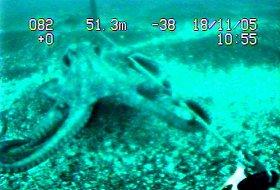
VICTORIA -- A giant Pacific octopus that attacked a remotely operated submarine off north Vancouver Island could have been senile or maybe just peckish, said a marine biologist yesterday.
"Large male octopuses in the last part of their lives become senescent, or senile," said Jim Cosgrove of the Royal B.C. Museum.
"They get to be like humans, doddering old fools that have inappropriate behaviours such as being out in the daytime," said Cosgrove, an expert in octopus behaviour, adding that it was probably trying to determine if the sub was edible.
The attack occurred on Nov. 18, 2005, off Brooks Peninsula, on the northwest coast of the island.
The Seaeye submarine was 55 metres below the surface. Mike Wood was on a boat on the surface, guiding it along the ocean floor while looking for electronic receivers that detect salmon.
"I had the ROV [remotely operated vehicle] with its manipulator claw attached on a ground rope," Wood said.
A tentacle shot forward very quickly and wrapped itself around the sub's manipulator claw, prompting Wood to immediately throw the sub into reverse and blast the octopus with sand and debris from the ocean floor.
On the video, the octopus whips its tentacles around as it tries to deal with the sub's counterattack.
"Eventually, it releases the vehicle and it gets blasted off into the distance," said Wood. The octopus was not injured, he said.
The Province, Page A28, 26-Jan-2006

Video
VICTORIA -- A giant Pacific octopus that attacked a remotely operated submarine off north Vancouver Island could have been senile or maybe just peckish, said a marine biologist yesterday.
"Large male octopuses in the last part of their lives become senescent, or senile," said Jim Cosgrove of the Royal B.C. Museum.
"They get to be like humans, doddering old fools that have inappropriate behaviours such as being out in the daytime," said Cosgrove, an expert in octopus behaviour, adding that it was probably trying to determine if the sub was edible.
The attack occurred on Nov. 18, 2005, off Brooks Peninsula, on the northwest coast of the island.
The Seaeye submarine was 55 metres below the surface. Mike Wood was on a boat on the surface, guiding it along the ocean floor while looking for electronic receivers that detect salmon.
"I had the ROV [remotely operated vehicle] with its manipulator claw attached on a ground rope," Wood said.
A tentacle shot forward very quickly and wrapped itself around the sub's manipulator claw, prompting Wood to immediately throw the sub into reverse and blast the octopus with sand and debris from the ocean floor.
On the video, the octopus whips its tentacles around as it tries to deal with the sub's counterattack.
"Eventually, it releases the vehicle and it gets blasted off into the distance," said Wood. The octopus was not injured, he said.
The Province, Page A28, 26-Jan-2006
Friday, January 20, 2006
Northern Bottelnose Whale

Race to save whale in London
Friday, January 20, 2006; Posted: 8:08 p.m. EST (01:08 GMT)
LONDON, England -- It's a whale of a tale -- a bottle-nosed whale swimming up the River Thames past Big Ben and Parliament on Friday as rows of worried Londoners looked on.
The northern bottle-nosed whale was spotted in central London in the afternoon -- the first sighting in the river since whale-watching records began in 1913 -- as it flailed around the murky waters of the Thames, stirring up patches of what looked like blood as seagulls hovered above and rescue boats stood on the ready.
Witness Tom Howard-Vyne said he saw the mammal swim under Westminster Bridge, near Big Ben. "I saw it blow. It was a spout of water which sparkled in the air," said Howard-Vyne. "It was an amazing sight."
Other witnesses reported seeing a second whale in another part of the river Friday, and marine experts spotted two disoriented whales off northeastern Scotland last week, suggesting something was causing bottle-nosed whales to become confused.
"It is a race against time to save the animal," said Alison Shaw, marine and freshwater conservation program manager at the Zoological Society of London.
A small armada of rescue boats made frantic searches for the whale, which disappeared from view around sunset after diving under the surface of the water. (Scenes from a whale's time in London)
Crews barricaded a section of river in an attempt to force the animal to change course and reports Friday evening claimed the mammal may be heading for safety.
Britain's Maritime and Coastguard Agency said the whale was last seen at Chelsea Bridge -- further downriver from earlier sightings, meaning the animal could be moving back out to sea. (See where the whale has wandered)
"A whale in the shallow water of the River Thames is like a human lost in the heat of the Sahara desert," said Laila Sadler, scientific officer at the Royal Society for the Prevention of Cruelty to Animals. She estimated it could survive only for 24 to 48 hours in a river that has an average depth of between 26 feet and 20 feet.
"It also seems to be in distress, it has made two seemingly deliberate attempts to beach itself," Sadler said.
Witnesses reported seeing injuries to the mammal, claiming its snout was bloodied. Photos also appeared to show damage to one of the whale's eyes and a number of cuts to its torso, though Sadler said these are not uncommon.
Several onlookers jumped into the river's 48-degree water -- after the mammal emerged, splashing to coax it away from shore.
The whale -- which is about 17 feet long -- is normally seen in the deep northern Atlantic, traveling in pods. They can reach 26 feet long -- the size of a red double-decker London bus.
When sick, old or injured, whales often get disoriented and swim off from their pod, said Mark Simmonds, science director at Whale and Dolphin Conservation Society, although witnesses reported seeing a second whale in a different section of the river Friday.
Scientists have said fluctuating ocean temperatures, predators, lack of food and even sonar from ships can send whales into waters that are dangerous for the mammals.
"It's going to be very confused. It's already stranded twice. The poor creature doesn't know where to go," said Tony Martin, a senior scientist with the British Antarctic Survey.
The whale drew hundreds of people and scores of television crews to the river's banks and captivated Londoners who called radio and television stations asking if they could help.
London's Natural History Museum said it was the first time a northern bottle-nose has been sighted in the Thames since it began records in 1913.
http://www.cnn.com/2006/WORLD/europe/01/20/
britain.whale/index.html
Saturday, December 24, 2005
Snub Nose Dolphin
NEW SPECIES OF DOLPHIN IDENTIFIED
A new dolphin species was identified by scientists off the coast of north Australia. The animals, which have been named snubfin dolphins were initially thought to be members of the Irrawaddy dolphin species, but DNA tests have confirmed them to be a distinct species. The snubfins are coloured differently and have different skull, fin and flipper measurement to the Irrawaddy dolphin. It is not known how many snubfin dolphins are in existence, but numbers are thought to be low, with a group of about 200 living off Townsville, north-east Australia.
For information on WDCS science and field projects around the world, please go to http://www.wdcs.org/fieldprojects
A new dolphin species was identified by scientists off the coast of north Australia. The animals, which have been named snubfin dolphins were initially thought to be members of the Irrawaddy dolphin species, but DNA tests have confirmed them to be a distinct species. The snubfins are coloured differently and have different skull, fin and flipper measurement to the Irrawaddy dolphin. It is not known how many snubfin dolphins are in existence, but numbers are thought to be low, with a group of about 200 living off Townsville, north-east Australia.
For information on WDCS science and field projects around the world, please go to http://www.wdcs.org/fieldprojects
Wednesday, December 07, 2005
Greeting Ceremony


One group of whales stopped, tightened up, and made surface vocalizations. Another group lined up in front of them and the two groups slowly travelled towards each other in lines. When they met, they dove and made some beautiful underwater vocalizations.
Wednesday, November 30, 2005
T7A

T7A has some new teeth marks on the left side of his saddle patch. This whale and a female transient (T7) were seen together in various passage of Clayqouot Sound from September 4 to 6, 2005.
Friday, November 18, 2005
Tuesday, November 15, 2005
ESA
The Southern Resident killer whales have been listed as Endangered under the United States Endangered Species Act.
Saturday, November 05, 2005
Subscribe to:
Posts (Atom)